
There are a few books I return back to again and again.
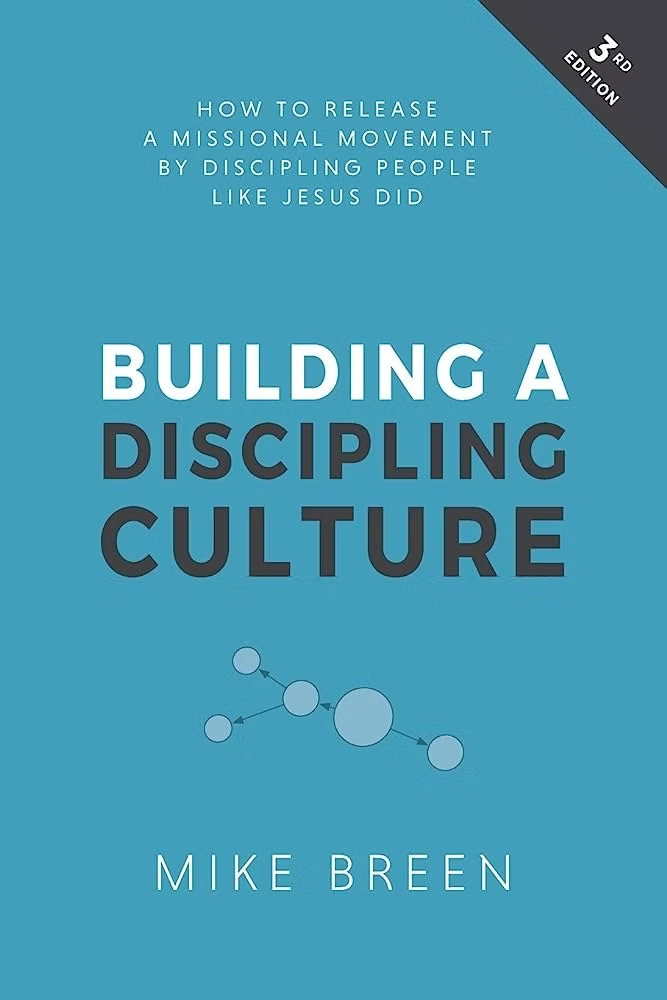
Building a Discipling Culture by Mike Breen is one of them.
Not because it offers a perfect solution, and not because I agree with everything in it—but because it puts words to things many Christians feel and struggle to articulate. Especially those who are still committed to Jesus, but increasingly disillusioned with how discipleship has been practiced in modern churches.
If you’ve ever wondered why so much church activity produces so little transformation, this book is worth spending time with.
The Idea That Changed How I Think About Discipleship
The most enduring contribution of Building a Discipling Culture is Breen’s framework for how people actually learn – when it comes to following Jesus and otherwise.
He argues that disciples are formed through the dynamic interplay of three kinds of learning:
- Information — what we know
- Imitation — who we follow and observe
- Immersion — the environment we’re shaped by
This makes immediate sense outside the church.
No one would want a heart surgeon who had only learned in a classroom but had never gone through residency—never apprenticed under a skilled surgeon, never been immersed in real-world practice. Knowledge alone doesn’t produce competence. Formation requires proximity, modeling, and lived experience.
Breen’s core claim is simple but unsettling: most churches try to make disciples almost entirely through information.
Why Information-Only Discipleship Falls Short
Modern church discipleship is often built around passive learning environments:
- classrooms
- lecture halls
- sermon-centric models
- discussion groups that rarely move beyond ideas
Information matters—but information alone forms consumers, not disciples.
Breen points out that apprenticeship is largely missing from church life. Not because leaders don’t care, but because our systems don’t make space for it. Time is scarce. Structures are rigid. Relationships stay shallow.
Immersion is often misunderstood as well.
Immersing spiritually immature people among other spiritually immature people doesn’t produce maturity—it simply reinforces existing patterns. Growth requires access to people who are already living the kind of life others are trying to learn.
When imitation and immersion are absent, discipleship stalls—even when activity is high.
“Trained for a World That No Longer Exists”
One line from the book has stayed with me more than almost any other:
“Most of us have been trained and educated for a world that no longer exists.”
It’s difficult to overstate how accurate this feels.
Many churches are still running systems, programs, and strategies designed for a cultural moment that has passed. Evangelism tools. Discipleship pipelines. Leadership development models. Even the language we use.
Much of the modern Christian training infrastructure was built for centuries past. These systems are slow to change, costly to adapt, and often staffed by people who are incentivized to preserve them rather than reimagine them. Meanwhile, the call to make disciples hasn’t changed at all.
The result is a growing disconnect between what churches are structured to do and what actually bears fruit in teaching to follow Jesus faithfully today.
Why Assembly-Line Discipleship Keeps Failing
Another of Breen’s critiques cuts close to the bone: many churches approach discipleship like an assembly line.
Create a program.
Run as many people through it as possible.
Measure success by participation.
But that isn’t how Jesus made disciples.
Jesus formed people through relational proximity and intentional challenge. He shared His life and His time. In other words, He invited people to apprenticeship – not an assembly line approach. His ministry was aimed at multiplication – not scalable efficiency.
When discipleship is built on mass production, the result is often a consumer mindset—where people depend on religious professionals to provide spiritual goods and services while a small percentage of leaders carry most of the weight.
Breen names the cost clearly: burnout, turnover, exhaustion, and shallow formation.
If you’ve ever been part of the group doing most of the work, this section of the book will feel painfully familiar.
The Question Everything Depends On
At the heart of Building a Discipling Culture is a question Breen insists we can’t avoid:
How do we actually make disciples?
Not how we grow attendance.
Not how we build organizations.
Not how we improve systems.
Disciples.
Breen’s distinction is clarifying:
“If you make disciples, you always get the church. But if you make a church, you rarely get disciples.”
In this framing, the church is not the cause of discipleship—it is the effect of it.
How Building a Discipling Culture Helped Me
This book helped me put language to a frustration I had felt for a long time.
It clarified why information-heavy approaches to faith so often feel disconnected from real life. It helped me see why discipleship stalls even in churches full of sincere, motivated people. And it challenged the assumption that better content or better programs would eventually fix the problem.
Most importantly, it reframed discipleship as something that must be intentional, relational, and embodied—not accidental or automated.
The book also helped me see that failure and messiness aren’t signs of doing discipleship wrong. They’re part of learning anything that actually matters. Formation takes time, practice, and patience.
Where Building a Discipling Culture Fell Short for Me
As the book moves from diagnosis into practice, it becomes more specific about language, shapes, and frameworks. While I don’t disagree with those tools, they aren’t the primary reason I continue to recommend the book.
The real value, for me, is in Breen’s analysis of the problem, not in copying his solutions wholesale. I believe Breen’s solutions worked for him, and like the analysis in the book suggests, we must continually tweak our approaches to optimize them for our contexts.
Different contexts require different expressions. What matters most is the underlying conviction: discipleship must involve more than information, and churches must resist the temptation to mass-produce what can only be formed through relationship.
Why I Still Recommend This Book
I don’t return to Building a Discipling Culture because it has everything figured out.
I return to it because it names realities many Christians experience but struggle to articulate. It explains why faith can feel stagnant even when church life is busy. And it challenges the assumption that the future of discipleship will look like the past.
For anyone reconstructing faith—especially those still committed to Jesus but wary of inherited systems—this book offers clarity without cynicism.
If that’s the season you’re in, it may be worth your time.
Leave a Reply